2026's Best Tools Like RocketReach—A Complete Overview
Fourteen RocketReach alternatives compared on price, free-tier volume, verification mechanism, phone data, and contract terms. All prices re-verified against vendor pricing pages in August 2026.
Something specific brought you here. A bounce report, a week of dead dials, or a renewal charge nobody on your team approved. You already know what RocketReach is, so we’ll skip that part. What follows is what replaces it, what each replacement costs this month, and how to test your shortlist on your own contacts before you hand anyone a card.
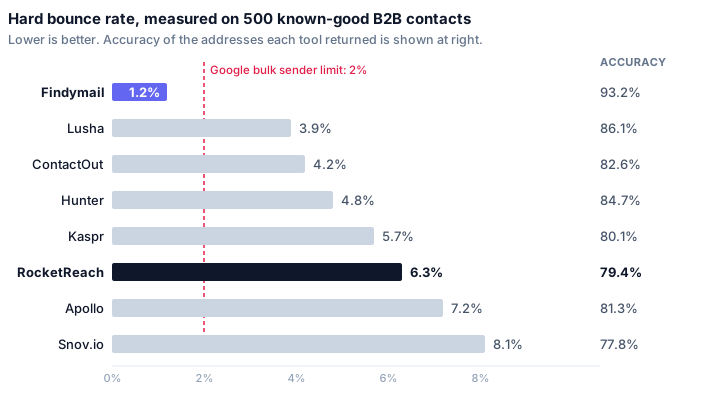
Where the ranking comes from. Findymail is first on this list because of our own accuracy benchmark, where we ran 500 known-good B2B contacts through eight tools and counted how many returned addresses were exactly right and how many bounced. RocketReach finished at 79.4% accuracy and a 6.3% bounce rate. Findymail finished at 93.2% and 1.2%. Six of the fourteen tools covered here weren't in that test, and each of those entries says so.
What we compared: starting price, real free-tier volume, verification mechanism, phone data, contract behavior, and who each tool serves.
Every price below was re-verified against the vendor's own pricing page in August 2026. Prices are what you pay month to month, with the annual-billing rate noted alongside where one exists — most comparisons quietly put one vendor's annualised rate next to another's monthly price, which can overstate a gap by 30% or more. Where a vendor publishes no price, the cell says that instead of guessing.
Don't take the ranking on trust. Findymail gives you 25 credits at signup, no card. That's still short of what it takes to validate a list, and the free-plans section names the tiers that clear the bar. It is enough to run a couple of dozen contacts whose addresses you already know and see whether our number survives contact with your data. The same invitation applies to every tool here. Your list is the only fair test.
Quick Fixes for Your RocketReach Concerns—Here’s How
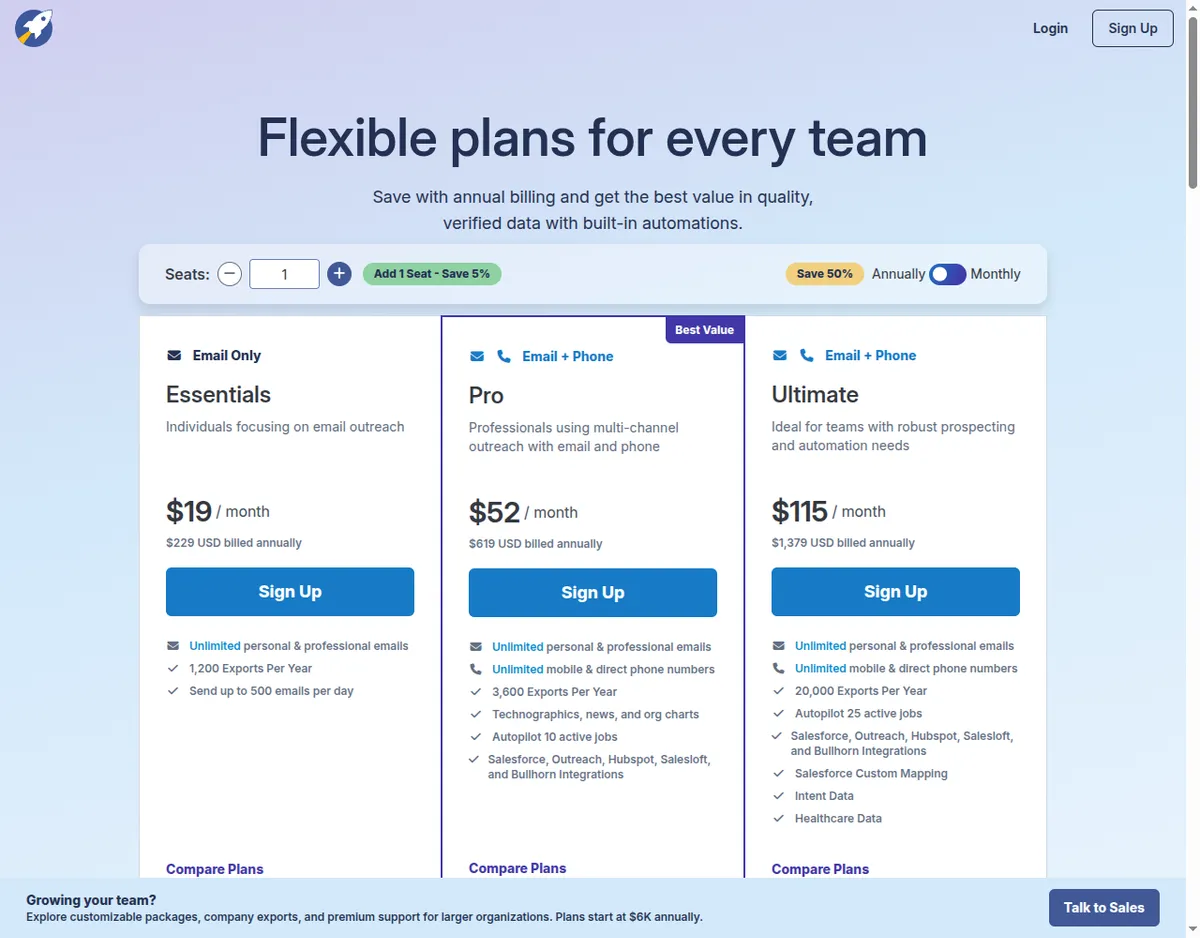
The yardstick. RocketReach, as of August 2026: Essentials $39/month for 100 lookups (email only), Pro $79/month for 250 lookups (adds mobile and direct phone), Ultimate $169/month for 1,000 lookups. Annual billing swaps the monthly lookup cap for “unlimited” lookups, then caps exports at 1,200, 3,600, or 20,000 a year. When we checked on 11 August 2026 the annual tab was running a “Save 50%” promotion at $19, $52, and $115 a month, so confirm what the toggle says on the day you buy. Free accounts get 5 lookups. Team plans start at $6,000 a year. Every price below is measured against those.
Find your complaint, then go where it points:
- Emails bounced on a real list. Findymail or UpLead. Both verify at the moment of lookup instead of handing you a stored record, and neither charges for a result it couldn’t confirm.
- A free tier big enough to test with. Apollo, at 900 credits per seat per year, granted monthly. Nothing else here gives you meaningfully more for nothing. Volumes in free plans.
- Dead phone numbers. Cognism or Lead411. Cognism phone-verifies a subset of its mobile data by hand. Lead411 puts direct dials in its $49/month entry plan.
- Per-seat math that punishes the team. Hunter or Lead411. Both sell volume, not seats, which is the opposite of RocketReach’s $6,000/year team floor.
- You need the outreach bundled, not just the data. Apollo if you want one tool. Instantly or Saleshandy if you want a sending platform and will buy data separately.
- You live in LinkedIn. Kaspr or LeadIQ. Both run inside Sales Navigator instead of asking you to leave it.
- Billing burned you. Read the exit section before you shop. RocketReach’s published policy is that payments are non-refundable and cancellation takes effect on the next cycle, so your renewal date decides your timeline.
Deciding if RocketReach is Still Right for Your Needs
RocketReach isn’t broken for everyone. A few things it does are hard to replace.
Stay if:
- You run a handful of ad-hoc lookups a month and live in the Chrome extension. At $39/month for 100 lookups, nothing here is meaningfully cheaper for that pattern.
- You need personal emails as well as work emails. Recruiters, mostly. Most tools on this list are work-email-only by design. RocketReach returns both and lets you filter by type.
- You use it as a directory: 700M+ profiles searchable by title, company, and location, for when you don’t yet know whose name you want.
- You value that a lookup gets refunded when RocketReach can’t verify an email or phone. That’s a real protection, published in their own FAQ, and several tools here don’t match it.
Switch if:
- Your last campaign’s bounce report is why you’re here. In our 500-contact test, 6.3% of the addresses RocketReach returned hard-bounced. Google’s bulk sender guidelines want you under 2%.
- Direct dials drive your outreach. Phone coverage is widely reported to lag the email data, and on G2 “outdated contacts” and “inaccurate data” are the two most-cited complaints.
- You’re adding seats. The self-serve tiers are per-seat, and pooled credits start at the $6,000/year team plan.
- The billing relationship is broken. Payments are non-refundable once a term starts. If that’s the grievance, what you need is a renewal-date plan, not a new vendor.
Stay column? You can stop here. Everyone else: the whole field is one screen down.
RocketReach and Its Rivals: An Easy Comparison
| Tool | Starting price | Free tier | Verification mechanism | Phone data | Contract behavior | Best for |
|---|---|---|---|---|---|---|
| RocketReach | $39/mo (100 lookups) | 5 lookups, once | Aggregated database, checked at lookup; lookup refunded if unverified | Pro tier and up | Monthly or prepaid annual; non-refundable, cancel effective next term | Ad-hoc solo lookups, personal emails |
| Findymail | $49/mo (1,000 credits) | 25 credits | Finds and verifies in one step; no charge for misses or duplicates | Yes, 10 credits each | Monthly or annual (2 months free); credits roll over to 2× plan | Cold email where bounce rate is the constraint |
| Apollo | $49/seat/mo annual (30k credits/yr) | 900 credits/seat/yr | Stored database records; verification is partial | Mobile credits included | Annual for list price (29% below monthly); 14-day trial | Data plus sequencing in one seat |
| ZoomInfo | No public pricing — confirm with vendor | None self-serve | Stored database records, research-team maintained | Yes, incl. direct dials | Annual contract, quoted per seat | Enterprise depth and intent data |
| Cognism | No public pricing — confirm with vendor | None; demo only | Stored records; a phone-verified subset is checked by humans | Strong (verified subset) | Annual; 5 seats included in packages | EU coverage and dial-heavy teams |
| UpLead | $74/mo annual, $99 monthly (170 credits/mo) | 5 credits, 7 days | Real-time verification when you unlock a contact | Available on higher tiers | Monthly available; annual is 25% cheaper | Small, high-value target lists |
| Lusha | $49.90/seat/mo (4,800 credits/yr) | 40 credits/mo | Contributed and partner data, verified at reveal | Yes, same credit pool | Monthly or annual; credits roll over to 2× on Pro+ | Enterprise contacts and extension work |
| Hunter | €34/mo annual, €49 monthly (2,000 credits/mo) | 50 credits/mo | Domain pattern detection plus its own verifier | None | Monthly or annual; volume-priced, not per seat | Email-only outbound on a budget |
| Kaspr | €45/seat/mo annual (unlimited B2B emails) | 15 emails + 5 phones/mo | Live LinkedIn profile enrichment | 1,200 phone credits/yr | Monthly or annual (25% off); auto-renews | Sales Navigator prospecting, EU data |
| LeadIQ | $150/mo annual, $200 monthly (up to 5 users) | 50 credits/mo | Stored records surfaced in-workflow | Yes, 10 credits each | Monthly or annual; 30-day trial on any plan | Capturing from Sales Navigator into the CRM |
| Lead411 | $49/mo (1,000 exports/mo) | 50 exports, 7 days | Stored records with a verified-email claim | Direct dials in base plan | Monthly or annual ($490/yr); volume-priced | Direct dials without an enterprise contract |
| Snov.io | $39/mo, $29.25/mo annual (1,000 credits) | 50 credits/mo, renewable | Pattern matching plus database; verifier sold separately | Add-on tokens only | Monthly or annual (40% off) | Cheapest data-plus-sequencing bundle |
| Seamless.AI | No public pricing — confirm with vendor | 50 credits, once | Live search-and-assemble at query time | Included in a credit | Annual credit packages; credits do not expire on paid plans | Teams that want one credit to cover email and phone |
| Instantly | $37.60/mo annual, $47 monthly | None | Sending platform; data sold as separate credits | No | Monthly or annual (20% off) | High-volume cold email infrastructure |
| Saleshandy | $36/mo, $25/mo annual (2,000 prospects) | 7-day trial | Sending platform; verification is a paid add-on | Dialer sold separately | Monthly or annual; 7-day trial, no card | Budget sequences with deliverability tooling |
How to read an accuracy claim
RocketReach advertises 98% accuracy on its pricing page. Cognism advertises 98% on its phone-verified subset. UpLead advertises 95%. Those numbers can’t all be right about the same contact, and none of them were measured on your list. They’re marketing claims. We print them as claims.
The mechanism is the part you can compare. Three questions get you there:
- When does the address get checked: at lookup, or whenever the record was last touched? Findymail and UpLead verify at the moment you request the contact. Apollo, ZoomInfo, Lead411, and LeadIQ serve a stored record. RocketReach checks at lookup and refunds the lookup when it can’t confirm anything, which beats most stored-record tools.
- Do you pay for results that turn out to be wrong? Findymail doesn’t charge for a miss or a duplicate, and refunds credits if your bounce rate exceeds 5%. RocketReach refunds the lookup itself. Most of the rest charge on delivery of a record, verified or not.
- What happens at a catch-all domain? This is where coverage numbers get manufactured. A catch-all accepts mail to any address, so SMTP can’t confirm the mailbox exists. Tools that return a pattern guess anyway post better coverage and quietly hand you the bounces. In our benchmark, the two tools that returned “not found” instead, Findymail and Lusha, had the lowest bounce rates and the correspondingly thinner coverage. That trade is the whole game. Our verification guide covers the mechanics.
Then run the test that settles it. Take 100 rows off your own target list, push them through two free tiers, send to what comes back, and count the bounces yourself. Volumes and instructions are in free plans.
What Makes These Tools Better Than RocketReach in 2026?
Twelve full entries, heaviest first. Every one carries the same six fields, cons included.
1. Findymail — verified-only results, with the bounce risk priced in
What it fixes about RocketReach: you stop paying for addresses that were correct whenever the database last looked. In our benchmark, RocketReach returned 79.4% correct addresses at a 6.3% bounce rate. Findymail returned 93.2% correct at 1.2%.
Mechanism: finding and verifying happen in one step, including a proprietary catch-all check. No verification, no result, no charge. Published guarantee: stay under a 5% bounce rate or get the credits back.
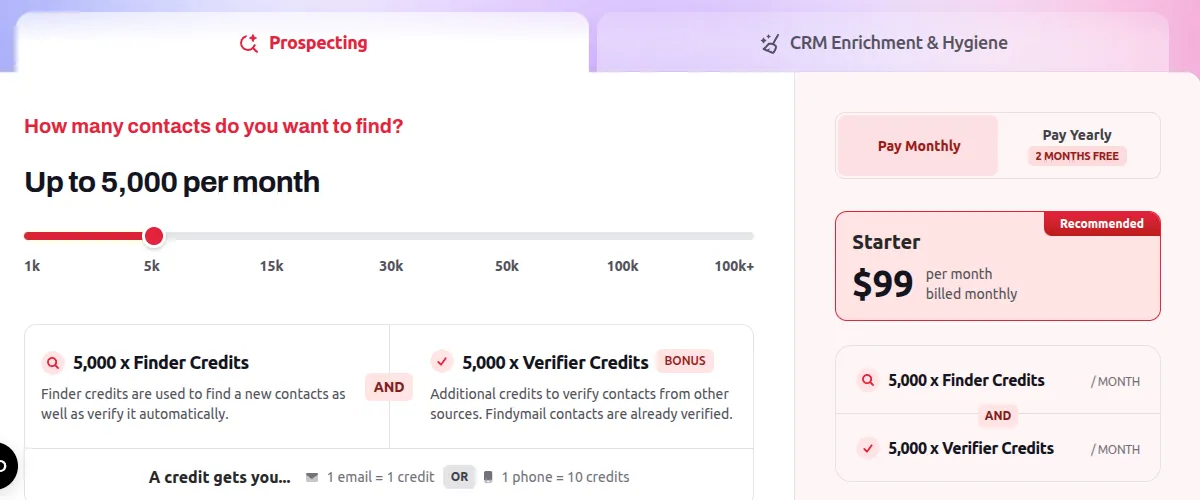
Price and contract (Aug 2026): $49/month for 1,000 finder credits (plus 1,000 verifier credits), $99/month for 5,000. Annual billing gives two months free. A phone number costs 10 credits. Unused credits roll over up to 2× your monthly allowance. Monthly plans, no lock-in.
Free tier: 25 credits, no card. Enough to spot-check contacts you already know. Not enough to validate a list.
Best for: teams whose constraint is deliverability, not list size. Cold email at volume, agencies sending on client domains, anyone who has already burned a sending domain once.
Cons:
- It’s a data tool with no sequencer. Results get pushed into Instantly, Smartlead, lemlist, or your CRM.
- 25 free credits still sits under the volume a real test needs. Proving it out costs $49.
- Coverage was 83.2% in our test, under Apollo’s 88.2%. Withholding unverifiable guesses explains it, but a miss is still a miss.
- Phones cost 10 credits each, so a dialing list gets expensive fast. This is an email-first tool.
Where RocketReach still wins: personal email addresses, a browsable 700M-profile directory for the days you don’t yet have a name, and a $39 entry price.
2. Apollo — the seat that replaces two tools
What it fixes about RocketReach: the per-lookup ceiling and the second subscription. RocketReach’s $39 tier buys 100 lookups a month and no sequencer; Apollo’s $49 seat buys 30,000 credits a year and sends the emails too.
Mechanism: a very large stored database (270M+ contacts) with partial verification. Freshness is the trade for size.
Price and contract (Aug 2026): Free; Basic $49/seat/month billed annually (30,000 credits/seat/year, granted upfront); Professional $79; Organization $119 with a 3-seat minimum. Monthly billing costs about 29% more. 14-day trial on paid plans.
Free tier: 900 credits per seat per year, granted monthly, so roughly 75 a month. Still the most usable free tier here.
Best for: teams that want lookup, sequencing, dialer, and pipeline in one seat, and who will add a verification step.
Cons:
- 7.2% bounce rate in our test, second-worst of the eight. Don’t send to Apollo data unverified. Pair it with a verification service, or run it as the second leg of a waterfall.
- List pricing assumes an annual commitment.
- Credits are granted upfront per year, so a mid-year seat reduction wastes them.
- Accuracy drops on enterprise (76.1%) and European (77.6%) contacts.
Full walkthrough: our Apollo.io guide. If Apollo is the tool you end up leaving next, our Apollo alternatives page covers that move.
3. ZoomInfo — depth RocketReach hasn’t got, at a price it doesn’t ask
What it fixes about RocketReach: org charts, intent, and research coverage on accounts where RocketReach returns a title from two jobs ago.
Mechanism: a large maintained database with a research operation behind it, plus contributed data. Records are stored, not verified at your moment of lookup.
Price and contract (Aug 2026): no public pricing. ZoomInfo blocks access to its pricing page and publishes no figures anywhere else. Expect a quoted annual contract with seat minimums and a procurement cycle. Confirm with the vendor before you budget.
Free tier: nothing self-serve.
Best for: enterprise sales orgs that need account intelligence, not just an address.
Cons:
- Annual commitment, quoted per seat. Not a tool you trial on a Tuesday.
- Not in our benchmark, so we have no first-party accuracy figure for it.
- Overkill, and overpriced, if all you wanted was RocketReach without the bounces.
4. Cognism — the one to call if the dials are dead
What it fixes about RocketReach: phone data, which is RocketReach’s weakest area and Cognism’s product thesis.
Mechanism: a stored contact database, plus a phone-verified subset (marketed as Diamond Data) that humans have called and confirmed. Cognism claims 98% accuracy on that subset. Read the claim carefully: it covers the subset, not the database.
Price and contract (Aug 2026): no public pricing. Standard and Pro packages, 5 seats included, credits allocated per contract, annual. Confirm with the vendor.
Free tier: none. Demo only.
Best for: teams calling into EU and UK markets, and anyone whose legal function asks where the data came from.
Cons:
- No self-serve entry and no free tier. You talk to sales or you don’t evaluate it.
- The verified-phone subset is a fraction of the database. The rest is ordinary stored data.
- Annual contract, which repeats the lock-in that may be why you’re leaving.
- Not in our benchmark.
5. UpLead — verification at the moment you unlock
What it fixes about RocketReach: the same bounce problem, pulled forward. You see the verification result at the moment you unlock the contact, not after the campaign.
Mechanism: real-time email verification when a contact is revealed. UpLead advertises a 95% accuracy standard, which is a vendor claim like all the others.
Price and contract (Aug 2026): Essentials $99/month, or $74/month billed annually (2,040 credits/year); Plus $199, or $149 annually (4,800/year); Professional is custom and annual-only.
Free tier: 5 credits over a 7-day trial. Effectively a demo.
Best for: small, high-value target lists where you care more about each contact being right than about volume.
Cons:
- The math turns hostile at volume. Essentials is 170 credits a month for $99, roughly $0.58 a contact, an order of magnitude above Hunter or Findymail per credit.
- Extra credits are $0.60 each, so overages don’t get cheaper.
- Not in our benchmark.
6. Lusha — the extension that holds up on enterprise contacts
What it fixes about RocketReach: accuracy on senior people at large companies. RocketReach fell to 81.2% on that segment in our test; Lusha hit 89.2%, its best result anywhere, and the one place its contributed-data model clearly earns its keep.
Mechanism: contributed and partner data, verified at reveal. Emails and phones draw on the same credit pool.
Price and contract (Aug 2026): Free; Starter $49.90/seat/month (4,800 credits/year); Pro $69.90 (7,200/year, 3 seats); Premium $399.90 (40,800/year). A seasonal discount of 25–35% was running when we checked, so confirm whether it’s still live before you compare. Credits roll over up to 2× the monthly cap on Pro and above.
Free tier: 40 credits a month, and it recurs. One of the few free tiers here that isn’t a one-time handout.
Best for: account-based selling into large enterprises, done from the browser extension.
Cons:
- Second-lowest coverage in our test at 69.8%. It finds fewer of the people you ask for.
- Phones eat the same credits as emails, so one dialing week empties the plan.
- Per-seat pricing, which may be the thing you’re trying to escape.
7. Hunter — email only, priced like it
What it fixes about RocketReach: the price of an email address when you don’t need phones, intent, or a directory. €34/month buys 2,000 credits.
Mechanism: domain-level pattern detection with source attribution, plus its own verifier. Domain Search lists everyone Hunter has indexed at a company, along with the pattern it inferred.
Price and contract (Aug 2026): Free; Starter €49/month, or €34 billed annually (2,000 credits/month); Growth €149/€104 (10,000); Scale €299/€209 (25,000). Priced by volume, not by seat.
Free tier: 50 credits a month, recurring.
Best for: email-only outbound, account mapping before an ABM push, and anyone doing the per-seat math.
Cons:
- No phone numbers at all. If you dial, this is the wrong tool.
- 84.7% accuracy and a 4.8% bounce rate in our test. Better than RocketReach, short of the verify-first tools.
- Weaker when you have a name but no company domain.
- Priced in euros, so your dollar cost drifts with the exchange rate.
Full walkthrough: our Hunter.io guide, and our Hunter alternatives page if you hit its limits later.
8. Kaspr — enrichment where you already are
What it fixes about RocketReach: the tab-switching. Kaspr runs inside LinkedIn and Sales Navigator instead of asking you to paste names into another product.
Mechanism: live enrichment against whichever profile is on your screen.
Price and contract (Aug 2026): Free; Starter €45/seat/month billed annually (unlimited B2B email credits, 1,200 phone credits/year, 12,000 exports/year); Business €79 (2,400 phone credits, 30,000 exports). Monthly billing runs about 25% higher. Subscriptions auto-renew, so set a reminder.
Free tier: 15 B2B email credits, 5 phone credits, and 5 direct-email credits a month.
Best for: SDRs whose whole day is Sales Navigator, and EU-focused prospecting. Kaspr states GDPR and CCPA alignment.
Cons:
- Lowest coverage in our benchmark at 61.3%. It misses four contacts in ten.
- 80.1% accuracy, barely above RocketReach.
- Phone credits are capped by year, so a heavy month borrows from a later one.
- The workflow assumes LinkedIn. It’s a poor fit for bulk CSV work.
9. LeadIQ — capture into the CRM, not into a spreadsheet
What it fixes about RocketReach: the copy-paste step. LeadIQ captures a prospect from Sales Navigator straight into Salesforce, Outreach, or Salesloft with the fields already mapped.
Mechanism: stored records surfaced inside the workflow. Credits: 1 for an email, 10 for a phone, 3 for account enrichment.
Price and contract (Aug 2026): Free; Pro from $200/month, or about $150/month billed annually, covering up to 5 users with volume scaling from 200 credits/month; Enterprise custom. 30-day trial on any plan.
Free tier: 50 credits a month for one user.
Best for: teams whose problem is CRM hygiene and rep workflow, not raw data quality.
Cons:
- The entry allocation is small for the price. You’re buying workflow, not volume.
- Not in our benchmark.
- Little reason to come here if bounces are the complaint.
10. Lead411 — direct dials without the enterprise contract
What it fixes about RocketReach: phone numbers locked behind a $79 tier, and the export caps that come with them. Lead411 puts verified emails and direct dials in a $49 entry plan with 1,000 exports a month.
Mechanism: stored records with a verified-email claim, plus buyer-intent data on the annual plans.
Price and contract (Aug 2026): Spark $49/month for 1,000 exports, or $490/year for 12,000; Ignite from $150/month or $1,500/year; Blaze is custom. Priced by volume, not by seat.
Free tier: 50 exports over a 7-day trial.
Best for: small teams that dial and can’t justify Cognism or ZoomInfo money.
Cons:
- Not in our benchmark, so we have no first-party accuracy figure.
- Intent data is an add-on on some plans, so quoted prices drift.
- The interface looks dated next to Apollo or Lusha.
11. Snov.io — the cheapest way to get data and sending together
What it fixes about RocketReach: the total bill. $39/month gets you 1,000 credits and a full sequencing suite. RocketReach’s cheapest tier gets you 100 lookups and no way to send.
Mechanism: pattern matching plus a database, with verification sold as separate credits. That separation matters, as the cons explain.
Price and contract (Aug 2026): Free trial; Starter $39/month (1,000 credits, 5,000 recipients), or $29.25/month billed annually; Pro S and Pro M reach 5,000 and 20,000 credits at $74.25 and $141.75 a month on annual billing. Annual discounts run up to 40%. Phone data only via add-on tokens at $0.02 each.
Free tier: 50 credits a month, renewable every 30 days.
Best for: founders and small teams running the whole outbound motion on one budget line.
Cons:
- Worst results in our benchmark: 77.8% accuracy, 8.1% bounce. Budget for the verification credits. They’re not optional here.
- Phones are an afterthought, sold as separate tokens that expire after 90 days.
- Cheap data plus a sending tool is exactly how domains get burned when the verify step gets skipped.
12. Seamless.AI — one credit for the email and the phone
What it fixes about RocketReach: the tiering. Phone numbers sit behind RocketReach’s $79 plan. Seamless folds email and phone into one credit at every level.
Mechanism: assembles contact data at query time instead of serving a fixed record.
Price and contract (Aug 2026): the free tier is published; Pro and Enterprise are quote-only. Annual credit packages, and credits don’t expire on paid plans. Confirm figures with the vendor.
Free tier: 50 credits, one time.
Best for: teams that want one credit to cover both channels and don’t mind a sales conversation.
Cons:
- No published price above the free tier, which turns budgeting into a phone call.
- Not in our benchmark.
- Assembling data at query time means quality tracks how big a footprint the prospect leaves online.
If you need the outreach bundled
The twelve above are data tools. If what you actually need is to send at volume, these two are sending platforms. You still buy the data somewhere else.
Instantly. Unlimited mailboxes and warmup, built for cold email volume. Growth $47/month, or $37.60 billed annually (1,500 credits); Hypergrowth $97/$77.60 (125,000 emails a month). Lead credits are sold as separate plans. No free tier. Cons: the data credits are a second line item, and the entry plan’s sending limits are modest for the money.
Saleshandy. The budget end, with deliverability tooling attached. Outreach Starter $36/month (2,000 prospects, 6,000 emails), or $25/month billed annually; Pro $99/$69; Scale $139 annualised. Email verification is a $19-per-5,000 add-on. 7-day trial, no card. Cons: verification costs extra, and prospect caps instead of credits make forecasting awkward.
Choose the Best Tool for Your RocketReach Issues
Your emails bounce. Shortlist Findymail and UpLead. Both verify at the moment of lookup, and neither hands you a record it couldn’t confirm. Findymail is the one we measured, at 1.2% bounce across 500 contacts. We haven’t tested UpLead, so judge it on its mechanism and not on its 95% claim. Test both against the free-plans section before you commit to either.
Cost per seat is the problem. Shortlist Hunter and Lead411. Both sell volume instead of seats, so a new rep doesn’t mean a new subscription. If the whole team needs one platform anyway, Apollo at $49 a seat covers the lookup tool and the sequencer at once. Different lever, same bill.
Your dialed numbers are dead. Email is RocketReach’s strong half. Phone is the weak one, and mobile coverage outside the US is weaker still. Trial Cognism for its human-verified mobile subset, or Lead411 for direct dials inside a $49 plan. Skip Hunter outright: it carries no phone data at all. And while Findymail does return phones, it charges 10 credits apiece, which makes it a poor fit when dialing is the main motion.
Compliance has to hold up. Cognism sells on a compliance-first posture with DNC screening. Kaspr states GDPR and CCPA alignment, with better EU coverage than the US-centric tools. Findymail publishes EU hosting and SOC 2 Type 2. The general point worth carrying into any vendor call: a business built on reselling a large stored database has to answer where each record came from and on what basis it’s being processed. Tools that find and verify on demand have a shorter answer. Treat that as a summary, not legal advice, and ask your own counsel about your market.
You need the outreach bundled. Three levels. Pick yours. Data only: Findymail, Hunter, UpLead, Cognism, all of which push into whatever you already send with. Data plus outreach: Apollo first, since one seat covers lookup and sequencing, with Snov.io at the budget end. Sending platform, data bought separately: Instantly and Saleshandy. Plainly: Findymail has no sequencer. If bundled outreach is the requirement, start with Apollo instead.
You live in LinkedIn. Kaspr runs on LinkedIn and Sales Navigator and is built for precisely this. LeadIQ captures from Sales Navigator into your CRM with the field mapping already done. Lusha is the strongest extension for enterprise contacts. Most of the data-first tools here, Findymail and Hunter included, ship Chrome extensions too, but their center of gravity is bulk work, not profile-by-profile prospecting.
Which Free Plans Let You Test Alternatives to RocketReach?
| Tool | Free monthly volume | Big enough to test on a real list? |
|---|---|---|
| Apollo | 900 credits/seat/year, granted monthly (~75/mo) | Yes |
| Hunter | 50 credits/mo | Yes, just |
| Snov.io | 50 credits/mo, renewable | Yes, just |
| LeadIQ | 50 credits/mo | Yes, just |
| Lusha | 40 credits/mo | Borderline |
| Lead411 | 50 exports, 7-day trial | Borderline, one shot |
| Seamless.AI | 50 credits, one time | Borderline, one shot |
| Findymail | 25 credits, one time | No, but enough to spot-check |
| Kaspr | 15 emails + 5 phones/mo | No |
| UpLead | 5 credits, 7-day trial | No |
| RocketReach | 5 lookups, one time | No. The reference case |
| ZoomInfo, Cognism | None; demo only | No |
The judgment. A free tier tells you something only if it clears about 50 contacts off your own list. Below that, one lucky or unlucky batch swamps the result. By that standard Apollo is the only tier here you can run a real test on more than once, while Hunter, Snov.io, and LeadIQ give you one proper run at 50 a month. RocketReach’s 5 lookups are the reference case for a free tier that exists to be a signup form. Findymail’s 25 credits go further, and it still doesn’t clear the bar, even though we rank it first: spot-check it for free, then pay $49 for a month if you want a verdict. Twenty-five contacts is a sniff test, not a result.
What to do today, at zero cost. Export 100 rows from a list you’ve already emailed, or one you’re about to. Strip the emails, keep the names and company domains. Run them through two free tiers from the top of this table. Then compare: how many each returned, how many match what you already know, and the only number that finally matters, how many bounce when you send. That’s a compressed version of the method behind our benchmark, and it beats every accuracy claim on this page, ours included.
Plan Your RocketReach Exit Mid-Contract: What to Know
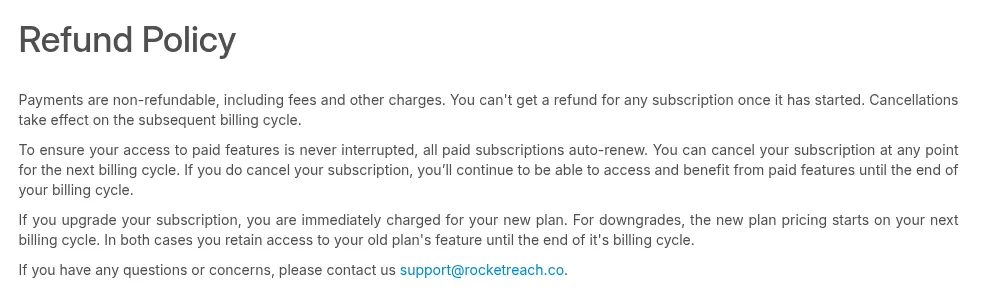
Check your renewal date first. RocketReach’s published refund policy says payments are non-refundable, that no subscription can be refunded once it has started, and that cancellations take effect on the following billing cycle. Its pricing FAQ adds that you keep plan access for the full term you paid for. So the answer splits two ways. On monthly billing, cancel whenever you like and you lose nothing but the current month. On an annual plan, you have already paid for the year. Cancelling early buys you nothing, and asking for the money back won’t work.
Which makes this a calendar exercise, not a negotiation. Find the renewal date. Use the 30 to 90 days before it to run the free-tier test above on real data. When the date lands, you’re switching to something you’ve already validated instead of guessing twice in a row.
None of this is an invented grievance. RocketReach’s Trustpilot page carries a long run of reviews about unexpected renewals, missing renewal reminders, and refused refunds, some from customers who cancelled the day after being charged and had used no credits. The published policy matches those accounts, which is rather the point. The terms are doing exactly what they say.
Which alternatives can’t repeat the injury:
| Tool | Billing model | Refund / rollover |
|---|---|---|
| Findymail | Monthly or annual | Credits roll over to 2× plan; credits refunded if bounce rate exceeds 5% |
| Hunter | Monthly or annual | Monthly cancellable; no rollover |
| Lusha | Monthly or annual | Rollover to 2× monthly cap on Pro and above |
| Lead411 | Monthly or annual | Monthly cancellable |
| Snov.io | Monthly or annual | Monthly cancellable |
| Apollo | Annual for list price | Credits granted upfront for the year |
| Kaspr | Monthly or annual | Auto-renews; annual phone credits pooled per year |
| LeadIQ | Monthly or annual | 30-day trial before you commit |
| Seamless.AI | Annual packages | Credits don’t expire on paid plans |
| UpLead | Monthly or annual | Monthly available at a 25% premium |
| ZoomInfo, Cognism | Annual contract | Negotiated; assume no mid-term exit |
If auto-renewal is what burned you, two notes. Kaspr states plainly that its subscriptions renew automatically. And the annual-contract vendors at the bottom of that table are structurally the same bet you’re trying to walk away from.
RocketReach Alternatives FAQ: Your Questions Answered
Which RocketReach alternative is free? Apollo, Hunter, Snov.io, LeadIQ, and Lusha all run recurring free tiers instead of one-time trials. Apollo’s is the largest, at roughly 75 credits a month. Exact volumes, and which ones are big enough to prove anything, are in free plans.
What’s better than RocketReach? Depends entirely on which part of it failed you. Bounces point to Findymail or UpLead. Dead dials point to Cognism or Lead411. Per-seat cost points to Hunter or Lead411. A missing sequencer points to Apollo. There’s no single answer here, and any page that hands you one is selling something. The routing section matches complaints to shortlists.
Which alternative has better phone numbers than RocketReach? Cognism, whose phone-verified subset gets called by humans before it reaches you, and Lead411, which puts direct dials in a $49 entry plan. Both beat RocketReach’s Pro tier when dialing is the main motion. More in the phones diagnosis.
Is Apollo cheaper than RocketReach? Per seat, they’re close: Apollo Basic is $49/seat/month billed annually against RocketReach Essentials at $39/month. Per contact, it isn’t close at all. Apollo’s seat carries 30,000 credits a year where RocketReach Essentials caps annual exports at 1,200, and Apollo throws in sequencing. The catch: Apollo’s data bounced at 7.2% in our test, so budget a verification step. That narrows the gap without closing it. Both price per seat, so neither one fixes team-level cost.
Which is better, ZoomInfo or RocketReach? They’re barely competing. ZoomInfo sells enterprise account intelligence, org charts and intent and research coverage, on an annual contract with no public price. RocketReach sells cheap self-serve lookups. If RocketReach is failing you on accuracy, ZoomInfo is an expensive way to fix that. If it’s failing you on depth, ZoomInfo is the obvious upgrade.
What are sites like RocketReach? The closest substitutes by shape, meaning self-serve, lookup-first, no sales call: Findymail, Hunter, UpLead, Apollo, Lusha, Lead411, and Snov.io. The heavier options (ZoomInfo, Cognism, Seamless.AI) put a sales conversation between you and a price.
How accurate is RocketReach’s data? RocketReach claims 98% accuracy on its own pricing page. In our test of 500 known-good B2B contacts, 79.4% of the addresses it returned were exactly right and 6.3% hard-bounced. Both figures can be true of different samples, which is exactly why every accuracy claim on this page, ours included, is a starting point for your own test and not an answer. The three mechanism questions in how to read an accuracy claim will tell you more than any percentage.