Apollo.io Alternatives in 2026: Replace the Bundle, or Unbundle It
Fourteen Apollo.io alternatives compared on price, credit allowance, verification mechanism, contract terms, and whether they replace the database, the sequencer, or both. Prices verified against vendor pages in August 2026.
Apollo sold you four things in one seat: a database, a sequencer, a dialer, and a pipeline view. You are probably not unhappy with all four. Work out which one is failing you before you shop, because the honest answer for most people leaving Apollo is not another all-in-one. It’s two cheaper tools that each do one job properly.
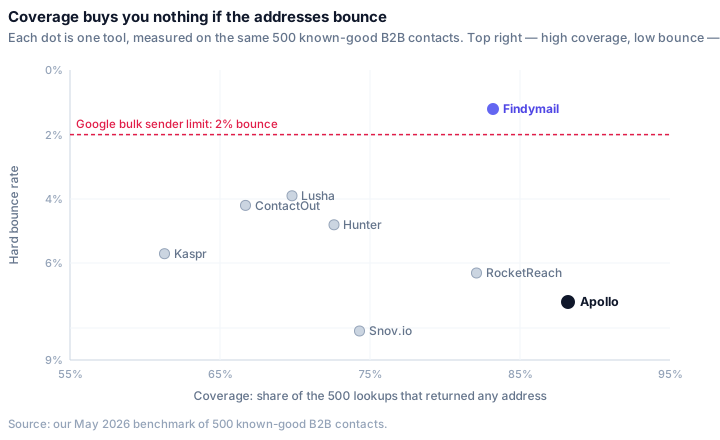
Where the ranking comes from. Apollo was one of eight tools in our accuracy benchmark: 500 known-good B2B contacts, run through every tool, scored on how many returned addresses were exactly right and how many bounced when we sent to them. Apollo posted the best coverage in the field, 88.2%, and the second-worst bounce rate, 7.2%. That single trade explains most of this page. Five of the fourteen tools below were not in that test, and those entries say so.
What we compared: starting price, what a credit actually buys, verification mechanism, whether sending is included, contract behavior, and who each tool serves.
Every price below was re-verified against the vendor's own pricing page in August 2026. Prices are what you pay month to month, with the annual-billing rate noted alongside where one exists — most comparisons quietly put one vendor's annualised rate next to another's monthly price, which can overstate a gap by 30% or more. Where a vendor publishes no price, the cell says that instead of guessing.
What Apollo Costs You Now, and Who Should Replace What
The yardstick. Apollo as of August 2026: Free at 900 credits per seat per year, granted monthly. Basic $49 per seat per month billed annually, with 30,000 credits per seat per year granted upfront. Professional $79. Organization $119 with a three-seat minimum. Monthly billing costs about 29% more than the list prices, and the Inbound and Advanced Dialer add-ons are $119 per team per month each. Paid plans come with a 14-day trial.
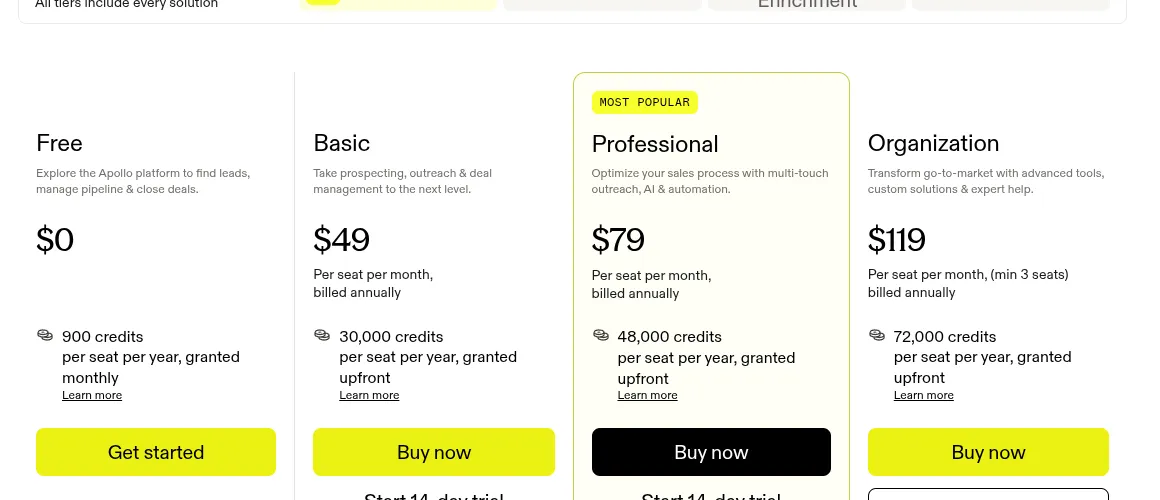
The credit allowance is the part people misread. 30,000 credits a year sounds enormous next to a tool selling 1,000 a month, and it is — until you notice that mobile numbers and some enrichment actions cost more than one credit, that the credits expire at the end of the term, and that they are granted per seat rather than pooled. Cheap credits that produce a 7.2% bounce rate are not cheap.
Your complaint, and where it points:
- The data bounces. Findymail or UpLead, then keep sending from whatever you already use. Or run Clay over multiple providers if you want one bad lookup to fall through to the next.
- You only ever used Apollo for the database. Prospeo or Lusha at the self-serve end, ZoomInfo or Cognism if you need enterprise depth or EU coverage.
- You only ever used it to send. Instantly, Smartlead, or lemlist. Buy data separately and you’ll usually spend less than the Apollo seat cost.
- You want one tool, just cheaper and less annoying. Snov.io is the closest like-for-like at a third of the price. Hunter if you’re email-only.
- Per-seat cost is the problem. Hunter, lemlist’s Email plan, and Smartlead all sell volume with unlimited or generous user counts instead of charging per rep.
- You’re stuck in an annual contract. Read the exit section first. Apollo’s terms of service make subscriptions non-cancelable during the term, so your only real lever is the renewal date.
Should You Actually Leave Apollo?
Apollo is a genuinely good deal for a specific shape of team, and the case for staying is stronger than the case for staying on most tools.
Stay if:
- You use at least three of the four products. Nothing on this page replaces database, sequencer, dialer, and deal tracking for $49 a seat, and assembling the equivalent from best-of-breed tools will cost you more.
- Coverage is what you need most. 88.2% in our test was the highest of any tool, and if your list is long-tail SMB contacts that other databases have never heard of, that matters.
- You already verify before sending. Apollo’s bounce problem is fixable with a $20 verification step; if you’ve built that step, the accuracy gap mostly closes.
- You’re on the free plan. 900 credits a year for a full platform is the most generous free tier in this category, and there’s no reason to abandon it.
Switch if:
- You send on a domain you can’t afford to burn. 7.2% of the addresses Apollo returned in our test hard-bounced, against Google’s 2% threshold, and 18.7% of what it returned sat on catch-all domains where nothing can be verified.
- You’re paying for seats that use one feature. Four products bundled into a per-seat price is expensive when your team touches one of them.
- You prospect into Europe. Apollo’s accuracy fell to 77.6% on our European segment and 76.1% on enterprise contacts.
- Your credits keep expiring unused. They’re granted for the term and forfeited at the end of it.
If you’re in the stay column, the useful move is a verification step rather than a migration. Everyone else: the field is below.
Apollo and the Alternatives, Side by Side
| Tool | Starting price | Free tier | Replaces | Verification mechanism | Contract behavior | Best for |
|---|---|---|---|---|---|---|
| Apollo | $49/seat/mo annual (30k credits/seat/yr) | 900 credits/seat/yr | — | Stored records, partial verification | Non-cancelable during term; credits expire with it | Teams using three of its four products |
| Findymail | $49/mo (1,000 credits) | 25 credits | Data | Finds and verifies in one step; no charge for misses | Monthly or annual; credits roll over to 2× | Sending on a domain you can't burn |
| Clay | From $54/mo annual (180k actions/yr) | 6,000 actions/yr | Data | Waterfalls across many providers, including Apollo | Monthly or annual; action bundles | Ops teams who want provider fallback |
| Prospeo | $37/seat/mo annual (24k credits/yr) | 100 credits/mo | Data | Database with verification at reveal | Monthly or annual; credits roll over | The Apollo database at a lower price |
| ZoomInfo | No public pricing — confirm with vendor | None self-serve | Data | Stored records, research-team maintained | Annual contract, quoted per seat | Enterprise depth and intent |
| Cognism | No public pricing — confirm with vendor | None; demo only | Data | Stored records plus a human-verified phone subset | Annual; 5 seats included | EU coverage and dial-heavy teams |
| UpLead | $74/mo annual, $99 monthly (170 credits/mo) | 5 credits, 7 days | Data | Real-time verification at unlock | Monthly available; annual 25% cheaper | Small, high-value target lists |
| Lusha | $49.90/seat/mo (4,800 credits/yr) | 40 credits/mo | Data | Contributed and partner data, verified at reveal | Monthly or annual; rollover to 2× on Pro+ | Enterprise contacts from the extension |
| Hunter | €34/mo annual, €49 monthly (2,000 credits/mo) | 50 credits/mo | Both, lightly | Domain patterns plus its own verifier | Monthly or annual; unlimited users | Email-only outbound without per-seat math |
| Snov.io | $39/mo, $29.25/mo annual (1,000 credits) | 50 credits/mo | Both | Patterns plus database; verifier sold separately | Monthly or annual (up to 40% off) | The closest like-for-like, far cheaper |
| lemlist | €55/mo annual, €69 monthly (Email plan) | 14-day trial | Both | 650M-lead database with finder and verifier | Monthly, quarterly or yearly; unlimited users on Email | Multichannel outreach with data attached |
| Instantly | $37.60/mo annual, $47 monthly | None | Sending | Sending platform; lead credits sold separately | Monthly or annual (20% off) | High-volume cold email infrastructure |
| Smartlead | $32/mo at the tier shown (yearly billing takes 17% off) | Free trial | Sending | Sending platform; verified prospect emails bundled | Monthly or yearly (17% off) | Agencies running many client workspaces |
| Saleshandy | $36/mo, $25/mo annual (2,000 prospects) | 7-day trial | Sending | Verification is a paid add-on | Monthly or annual; 7-day trial, no card | Budget sequences with deliverability tooling |
| Outreach | No public pricing — confirm with vendor | None | Sending | Not a data provider | Seats plus AI-credit consumption, quoted | Enterprise sequencing and forecasting |
How to read a credit allowance
Apollo’s headline number is credits, and credits are the easiest thing in this market to misread. Four questions turn an allowance into a real cost:
- What does one credit buy? An email is one credit almost everywhere. A mobile number is ten at Findymail and LeadIQ, one at Seamless, and drawn from the same pool as emails at Lusha. Compare on the action you actually perform.
- Per seat, or pooled? Apollo grants credits per seat. Two reps who use 5% of their allowance each cannot lend it to the third who ran out. Hunter, Smartlead and lemlist’s Email plan sell volume against unlimited or generous user counts instead.
- What happens to what you don’t spend? Apollo’s expire with the term. Findymail, Lusha, Prospeo, Skrapp and Anymailfinder all roll unused credits forward to some cap. That is a real discount that never appears in a price comparison.
- Are you charged for a result you can’t use? This is the one that costs the most and shows up nowhere on a pricing page. A tool that charges for an unverifiable catch-all guess is selling you a bounce at list price. In our test, 18.7% of what Apollo returned sat on catch-all domains.
Then run the test that settles it: pull 100 rows off a real list, run them through two free tiers, send, and count the bounces yourself. Volumes are in free plans.
The Fourteen Alternatives, and What Each One Actually Replaces
Replacing the data
1. Findymail — for when the sending domain is the asset
What it fixes about Apollo: the bounce rate. In our benchmark Apollo returned addresses that bounced at 7.2%; Findymail’s bounced at 1.2%, with accuracy of 93.2% against Apollo’s 81.3%.
Mechanism: finding and verifying happen in one step, including a catch-all check. If it can’t verify, it returns nothing and charges nothing. Published guarantee: under 5% bounce rate or your credits come back.
Price (Aug 2026): $49/month for 1,000 finder credits plus 1,000 verifier credits, $99/month for 5,000. Two months free on annual. A phone costs 10 credits. Credits roll over to 2× your allowance.
Free tier: 25 credits, no card.
Best for: teams who send from their own domain at volume, and agencies sending on client domains.
Cons:
- No sequencer, no dialer, no pipeline view. Replacing Apollo with this means buying a sending tool too.
- Coverage was 83.2% against Apollo’s 88.2%: on a long-tail SMB list you will find fewer people.
- Phones at 10 credits each make it a poor dialer list.
2. Clay — stop betting on one database
What it fixes about Apollo: the single-provider gamble. Clay runs a waterfall — try provider one, and when it comes back empty, fall through to two and three automatically. Apollo can even be one of the providers in it.
Mechanism: orchestration rather than data. Clay resells lookups from dozens of vendors and lets you chain them, then enrich with AI agents.
Price (Aug 2026): free tier with 6,000 actions a year. Paid plans are sold as annual action bundles starting at 180,000 actions a year, showing at $54/month when we checked, with a separate data-credit allowance on top. Monthly billing costs more.
Free tier: 6,000 actions and 1,200 data credits a year, unlimited seats.
Best for: ops teams and agencies who want coverage without accepting one vendor’s bounce rate.
Cons:
- Pricing in “actions” is the least comparable model on this page. Do the arithmetic before you commit.
- It’s a build, not a buy. Someone has to own the tables.
- You still pay the underlying providers’ rates through Clay’s credits.
Our waterfall enrichment guide walks through the same pattern with and without Clay.
3. Prospeo — the Apollo database shape, at a lower price
What it fixes about Apollo: the seat price and the expiring credits, without giving up filtered search. 41 search filters, intent topics, CRM sync, lookalikes.
Mechanism: a searchable B2B database with verification at reveal.
Price (Aug 2026): Free; Starter $49/seat/month, or $37 billed yearly, for 24,000 credits per user per year; Growth $99/$74 for 60,000; Pro $249/$187 for 180,000. Unused credits roll over.
Free tier: 100 credits a month, recurring — the largest free allowance on this page.
Best for: people who bought Apollo for search-and-export and never opened the sequencer.
Cons:
- Not in our benchmark; we have no first-party accuracy figure.
- Still per-seat, so it fixes the price but not the pricing model.
- Smaller ecosystem and fewer native integrations than Apollo.
4. ZoomInfo — the upgrade, priced like one
What it fixes about Apollo: depth on enterprise accounts, org charts, and intent, where Apollo’s accuracy fell to 76.1% in our test.
Mechanism: a large maintained database with a research operation behind it.
Price (Aug 2026): no public pricing. ZoomInfo blocks access to its pricing page and publishes no figures. Expect an annual contract, seat minimums, and procurement.
Free tier: nothing self-serve.
Best for: enterprise sales orgs where account intelligence, not address volume, is the constraint.
Cons:
- Annual commitment quoted per seat, which is a heavier version of the lock-in you may be leaving.
- Not in our benchmark.
- Wildly disproportionate if your actual problem is bounces.
5. Cognism — for dialing and for Europe
What it fixes about Apollo: phone quality and EU coverage, the two places Apollo is weakest.
Mechanism: a stored database plus a phone-verified subset (Diamond Data) that humans have called. The 98% accuracy claim covers that subset, not the whole database.
Price (Aug 2026): no public pricing. Standard and Pro packages, 5 seats included, credits allocated per contract, annual.
Free tier: none. Demo only.
Best for: teams calling into EU and UK markets under a compliance regime.
Cons:
- No self-serve entry and no free tier.
- Annual contract.
- Not in our benchmark.
6. UpLead — verification you can see happening
What it fixes about Apollo: you learn whether the address is deliverable at the moment you unlock it, not after the campaign.
Mechanism: real-time verification at reveal. UpLead advertises a 95% accuracy standard, which is a vendor claim like all the others.
Price (Aug 2026): Essentials $99/month, or $74 billed annually, for 170 credits a month; Plus $199/$149 for 400; Professional custom and annual-only.
Free tier: 5 credits over 7 days.
Best for: short target lists where each contact matters more than volume.
Cons:
- Roughly $0.58 a contact at the entry tier against Apollo’s fractions of a cent. This is the opposite end of the market.
- Overage credits are $0.60 each.
- Not in our benchmark.
7. Lusha — the extension that holds up on enterprise names
What it fixes about Apollo: accuracy on senior people at large companies, where Lusha hit 89.2% in our test and Apollo managed 76.1%.
Mechanism: contributed and partner data, verified at reveal. Emails and phones share one credit pool.
Price (Aug 2026): Free; Starter $49.90/seat/month for 4,800 credits a year; Pro $69.90 for 7,200 across 3 seats; Premium $399.90 for 40,800. A 25–35% seasonal discount was running when we checked. Credits roll over to 2× the monthly cap on Pro and above.
Free tier: 40 credits a month, recurring.
Best for: account-based selling into large enterprises.
Cons:
- 69.8% coverage in our test, well under Apollo’s 88.2%.
- Phones and emails draw down the same credits.
- Per-seat, and the list price is high next to Prospeo or Findymail.
8. Hunter — email only, unlimited users
What it fixes about Apollo: per-seat pricing. Hunter charges for volume and lets the whole team in, and it now sends campaigns as well as finding addresses.
Mechanism: domain-level pattern detection with source attribution, plus its own verifier.
Price (Aug 2026): Free; Starter €49/month, or €34 billed annually, for 2,000 credits a month; Growth €149/€104 for 10,000; Scale €299/€209 for 25,000.
Free tier: 50 credits a month, recurring.
Best for: small teams doing email-only outbound who resent paying per rep.
Cons:
- No phone numbers at all.
- 72.6% coverage in our test, the fourth-lowest, and weak when you have a name but no domain.
- The campaign tooling is real but basic next to Apollo’s sequencer.
Full walkthrough in our Hunter.io guide, and if Hunter itself is what you’re replacing, our Hunter alternatives page.
Replacing the whole platform
9. Snov.io — the closest like-for-like, at a third of the price
What it fixes about Apollo: the bill. $39/month buys 1,000 credits, unlimited campaigns, unlimited senders and warm-up. That’s the Apollo shape without the Apollo seat price.
Mechanism: pattern matching plus a database, with verification sold as separate credits.
Price (Aug 2026): Free trial; Starter $39/month for 1,000 credits and 5,000 recipients, or $29.25/month billed annually; Pro S and Pro M reach 5,000 and 20,000 credits at $74.25 and $141.75 a month on annual billing. Annual discounts run up to 40%. Phone data only via add-on tokens at $0.02 each.
Free tier: 50 credits a month, renewable every 30 days.
Best for: founders and small teams running the whole motion on one line item.
Cons:
- Worst results in our benchmark: 77.8% accuracy, 8.1% bounce. Worse than Apollo on the exact axis that makes people leave Apollo.
- Buy the verification credits. On this tool they are not optional.
- Phones are an afterthought sold as expiring tokens.
10. lemlist — multichannel, with the data included
What it fixes about Apollo: the channel ceiling. Email, LinkedIn, calls, WhatsApp and SMS run in one sequence, against a 650M-lead database with its own email and phone finder.
Mechanism: database plus finder and verifier, wrapped in a multichannel sequencer.
Price (Aug 2026): Email €69/month, or €55 yearly, with unlimited users and 50,000 emails a month; Multichannel €109/month, or €87 yearly, per user; Enterprise custom. Quarterly billing saves 10%, yearly 20%. 14-day free trial.
Free tier: none beyond the trial.
Best for: teams whose reply rates depend on touching people somewhere other than the inbox.
Cons:
- The Multichannel plan is per user, so the per-seat math returns.
- Not in our benchmark.
- More product than a pure data buyer needs.
11. Instantly — sending infrastructure at volume
What it fixes about Apollo: deliverability headroom. Unlimited mailboxes and warm-up, built for people sending more than a platform seat comfortably allows.
Price (Aug 2026): Growth $47/month, or $37.60 annually, including 1,500 credits; Hypergrowth $97/$77.60 for 125,000 emails a month; Lightspeed $358/$286.30. Lead credits are sold as separate plans.
Free tier: none.
Best for: high-volume cold email where infrastructure is the bottleneck.
Cons:
- Data is a second line item.
- No free tier to evaluate on.
- Entry sending limits are modest for the money.
12. Smartlead — for agencies running many workspaces
What it fixes about Apollo: client separation. Unlimited client workspaces, white-labelling, and verified prospect emails bundled into the sending plan.
Price (Aug 2026): Base $32/month for 2,000 contacts, 6,000 sends and 2,000 verified emails; Pro $78 for 30,000 contacts and 90,000 sends; Unlimited Smart $144 for 150,000 sends and 50,000 verified emails; Unlimited Prime $315. Yearly billing saves 17%. Mailboxes and domains are sold as add-ons from about $4.50 a mailbox a month.
Free tier: free trial.
Best for: lead gen agencies who need per-client isolation and their own branding.
Cons:
- The add-on menu (mailboxes, servers, dialer, verification) makes the real monthly cost hard to predict.
- Not a data tool: the bundled verified emails are a sending convenience, not a prospecting database.
- Not in our benchmark.
If it’s only the sequencer you want to replace
Saleshandy. The budget end of sending, with deliverability tooling attached. Outreach Starter $36/month for 2,000 prospects and 6,000 emails, or $25/month billed annually; Pro $99/$69; Scale $139 annualised. Verification is a $19-per-5,000 add-on. 7-day trial, no card. Cons: prospect caps rather than credits make forecasting awkward, and verification costs extra.
Outreach. The enterprise answer, and the one Apollo is usually compared to at the top of the market. No public pricing: seat-based licensing combined with consumption-based AI credits, quoted per team. Not a data provider, so you bring your own. Cons: procurement cycle, annual commitment, and a floor well above anything else on this page.
Match Your Apollo Complaint to a Shortlist
Your emails bounce. Shortlist Findymail and UpLead, both of which verify at lookup rather than serving a stored record. If you’d rather keep Apollo’s coverage, the cheaper fix is a verification step: run exports through a bulk verifier before they enter a sequence, which costs cents per contact and solves most of the problem without a migration.
You’re paying per seat for one feature. Shortlist Hunter and Smartlead, or lemlist’s Email plan, all of which sell volume with unlimited or generous user counts. The test is simple: divide your Apollo bill by the number of people who opened it last month.
You need coverage Apollo doesn’t have. No single database wins everywhere, which is why Clay exists. A waterfall of two or three providers reached 94.2% coverage in our testing against 88.2% for Apollo alone.
You dial. Apollo’s mobile credits are real but its phone data isn’t its strength. Cognism human-verifies a subset of mobiles; Lusha is strong on senior contacts. Both cost more per number than Apollo, and both will waste less of your reps’ morning.
You prospect into Europe. Apollo fell to 77.6% accuracy on our European segment. Cognism and Kaspr are built for that market, and a database whose records were assembled under a different regulatory regime is worth asking your legal team about before it lands in your CRM.
You want to spend less and keep everything. Snov.io is the honest answer, with the honest caveat: it tested worse than Apollo on accuracy and bounce rate. You are trading data quality for price, so budget the verification credits from day one.
Which of These Can You Test Without Paying?
| Tool | Free volume | Big enough to test on a real list? |
|---|---|---|
| Prospeo | 100 credits/mo | Yes |
| Apollo | 900 credits/seat/yr (~75/mo) | Yes — the reference case |
| Hunter | 50 credits/mo | Yes, just |
| Snov.io | 50 credits/mo, renewable | Yes, just |
| Lusha | 40 credits/mo | Borderline |
| Findymail | 25 credits, one time | No, but enough to spot-check |
| UpLead | 5 credits, 7 days | No |
| Clay | 6,000 actions + 1,200 data credits/yr | Yes, with setup work |
| lemlist, Smartlead, Saleshandy | 7 to 14-day trials | Time-boxed, not volume-boxed |
| Instantly, Outreach | None | No |
| ZoomInfo, Cognism | None; demo only | No |
The judgment. Apollo’s own free plan is the most useful one in this category, which is the awkward fact at the middle of this page: the cheapest way to evaluate an Apollo alternative is often to keep an Apollo free seat as your coverage baseline and test challengers against it. Prospeo’s 100 credits a month is the only recurring free tier that beats it outright. Everything else here is either a time-boxed trial, which tells you about the interface and nothing about the data, or a handful of credits.
What to do this week, at zero cost. Take 100 rows from a list you’ve already emailed, so you know the ground truth. Strip the addresses. Run the names and domains through Apollo’s free tier and one challenger. Compare three numbers: how many each returned, how many matched what you already knew, and how many bounced when you sent. That is our benchmark method compressed into an afternoon, and it beats every accuracy claim on this page, ours included.
Leaving an Apollo Contract Without Losing the Year
Read your term before you shop. Apollo’s terms of service are explicit: “Subscriptions are non-cancelable during the Term and all payments by you are nonrefundable,” and subscription fees “cannot be decreased during the relevant Subscription Term.” So mid-term there is no refund, no downgrade, and no seat reduction. What you have is a renewal date and the notice period in your order form, which is where any non-renewal requirement will be written down.
That makes the sequence a calendar exercise. Find the renewal date. Check the order form for how much written notice non-renewal takes. Use the weeks before that deadline to run the free-tier test above, so you’re switching to something you’ve measured rather than something you read about.
One detail costs teams real money at the end of an annual term: credits are granted for the term and expire with it. If you’re not renewing, spend them. A last-month bulk export of everything you’ll want for the next quarter is worth more than the credits are once the term closes.
Which alternatives can’t repeat the injury:
| Tool | Billing model | Credits and exit |
|---|---|---|
| Findymail | Monthly or annual | Roll over to 2× plan; refunded if bounce rate exceeds 5% |
| Prospeo | Monthly or annual | Unused credits roll over |
| Hunter | Monthly or annual | Cancel any time; no refund for the unused portion |
| Lusha | Monthly or annual | Rollover to 2× monthly cap on Pro and above |
| Snov.io | Monthly or annual | Monthly cancellable |
| Smartlead | Monthly or yearly | Monthly cancellable; add-ons billed separately |
| Instantly | Monthly or annual | Monthly cancellable |
| lemlist | Monthly, quarterly or yearly | Monthly cancellable |
| Clay | Monthly or annual | Action bundles sized per year |
| UpLead | Monthly or annual | Monthly available at a 25% premium |
| ZoomInfo, Cognism, Outreach | Annual contract | Negotiated; assume no mid-term exit |
The pattern worth noticing: every tool that sells credits by the month lets you leave, and every tool that sells a platform by the year does not.
Apollo Alternatives: Common Questions
What is the best free alternative to Apollo.io? Prospeo, at 100 credits a month, is the only recurring free tier that beats Apollo’s own. Hunter and Snov.io both give 50 a month and Lusha gives 40. Volumes and the caveats are in free plans.
Is there a cheaper tool that does everything Apollo does? Snov.io, at roughly a third of Apollo’s per-seat price with sequencing included. The trade is data quality: it finished last in our benchmark on both accuracy and bounce rate, so you’ll spend part of the saving on verification.
Should I replace Apollo with one tool or two? Count the products you use. If it’s one, unbundling is almost always cheaper — a data tool plus a sending tool typically lands between $70 and $100 a month for a small team, against $49 per seat per month for a bundle you use a quarter of. If it’s three or more, staying is usually the rational move.
Is Apollo’s data actually bad? It’s the most complete and among the least deliverable. In our 500-contact test it returned an address for 88.2% of lookups, more than anything else we tried, and 7.2% of those hard-bounced. Both facts are true at once, and which one governs depends on whether you’re building a list or sending to it.
What do I use for phone numbers instead? Cognism for human-verified mobiles, Lusha for senior contacts, Lead411 for direct dials inside a $49 plan. Apollo’s mobile credits work, but phone data is not what it’s best at.
Can I get a refund on my Apollo annual plan? No. Apollo’s terms make subscriptions non-cancelable during the term and payments nonrefundable, and unused credits expire with the term rather than being refunded. Plan around the renewal date instead — see the exit section.
Is Clay an Apollo alternative or something else? Something else that solves the same problem. Clay doesn’t own a database; it queries other people’s and falls through to the next when one comes up empty. If your complaint is “Apollo missed 12% of my list,” that’s the structural fix. If your complaint is “Apollo costs too much,” it isn’t.