Hunter.io Alternatives in 2026: What You Hit the Wall On
Fourteen Hunter.io alternatives compared on price per credit, free tier, coverage, phone data, and GDPR posture. Prices verified against vendor pricing pages in August 2026.
Hunter does one thing, does it cheaply, and doesn’t charge per seat. People rarely leave because it’s bad. They leave because they hit one of its four walls: no phone numbers, nothing useful when you have a name but no company domain, a coverage ceiling on smaller companies, or the point where the workflow needs more than an address. Work out which wall you hit, because three of the four have cheap answers and one of them doesn’t.
Where the ranking comes from. Hunter was one of eight tools in our accuracy benchmark: 500 known-good B2B contacts, scored on how many returned addresses were exactly right and how many bounced when we sent to them. Hunter finished third on accuracy at 84.7%, with a 4.8% bounce rate and 72.6% coverage. That profile — usually right when it answers, silent more often than the big databases — is the thing to hold in mind while reading the rest of this page. Seven of the fourteen tools below were not in that test, and those entries say so.
What we compared: real cost per lookup, free-tier volume, whether you pay for results that fail, phone data, seat policy, and GDPR posture.
Every price below was re-verified against the vendor's own pricing page in August 2026. Prices are what you pay month to month, with the annual-billing rate noted alongside where one exists — most comparisons quietly put one vendor's annualised rate next to another's monthly price, which can overstate a gap by 30% or more. Where a vendor publishes no price, the cell says that instead of guessing.
Hunter’s Limits, and the Tool That Answers Each One
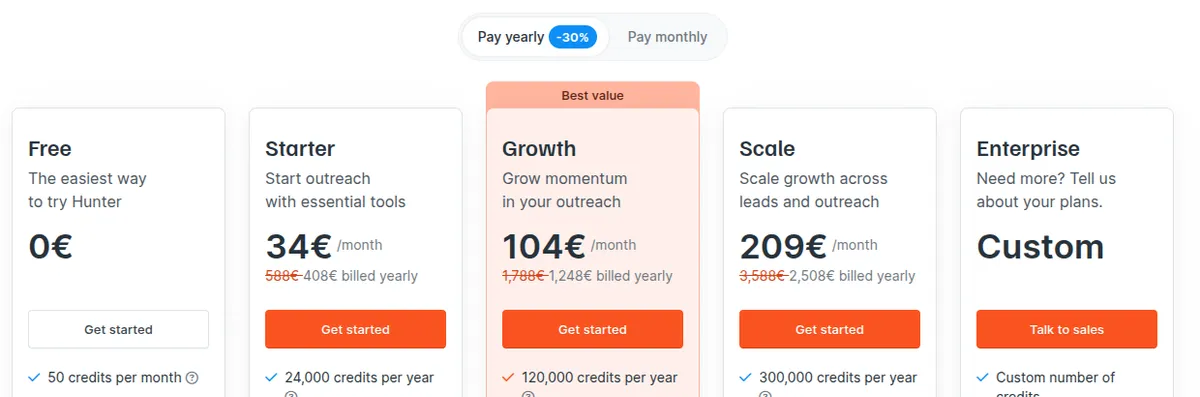
The yardstick. Hunter as of August 2026: Free at 50 credits a month. Starter €49/month, or €34 billed yearly, for 2,000 credits a month. Growth €149/€104 for 10,000. Scale €299/€209 for 25,000. Enterprise custom. Yearly billing takes 30% off, and every plan includes unlimited users. That is rarer than it sounds, and worth counting before you switch.
Which wall did you hit:
- You need phone numbers. Kaspr at the cheap end, Cognism if dialing is the whole job. Hunter carries no phone data at any tier, and no amount of upgrading changes that.
- You have a name and a LinkedIn URL, not a domain. Skrapp, ContactOut, or Kaspr work from the profile. Hunter’s model starts at the domain.
- You need to build the list, not just resolve it. Apollo or Prospeo let you filter a database by industry, headcount and title. Hunter finds people at companies you already named.
- Coverage is too thin. Findymail at 83.2% in our test against Hunter’s 72.6%, or Anymailfinder, which charges only when it finds a verified address.
- Per-credit cost at volume. On month-to-month billing Hunter’s entry tier is about €0.025 a credit, Skrapp about $0.020, and Anymailfinder falls to €0.007 once you commit annually at volume.
- You’re in Europe and your DPO asks questions. Dropcontact computes addresses instead of reselling a database, and is audited against CNIL standards.
- What you actually need is verification, not finding. ZeroBounce or MillionVerifier, both cheaper per check than a finder credit.
Is Hunter Still the Right Tool for You?
Hunter is one of the few tools on this site where the stay case is genuinely strong, so here it is properly.
Stay if:
- Your workflow starts from a company. Domain Search is still the best answer in this category to “who works here and what’s the email pattern,” and it shows its sources.
- You have a team. Unlimited users on every plan, including Free, is unusual: Apollo, Lusha, Prospeo and Kaspr all charge per seat, so a five-person team can pay five times as much elsewhere for the same volume.
- You send from your own domain and care about bounces. 4.8% in our test is not the best on this page, but it’s better than Apollo’s 7.2%, RocketReach’s 6.3% and Snov.io’s 8.1%.
- You want the whole loop cheaply. Finding, verification and basic campaigns now sit in one €34 subscription.
Switch if:
- You dial. There is no phone data, and there is no plan that adds it.
- Your prospects are at companies too small or too new for a pattern to exist. Coverage was 72.6% in our test: better than Kaspr or ContactOut, well behind Apollo’s 88.2%.
- You start from a LinkedIn profile, not from a website.
- You need enrichment beyond the address — job changes, firmographics, intent — to feed a CRM.
If you’re in the stay column, the cheapest upgrade is usually not a new finder. It’s Hunter plus one specialist for the gap: Hunter for domains and Kaspr for the phones, say, at about €80 a month combined.
Hunter and the Alternatives, Side by Side
| Tool | Starting price | Approx. cost per lookup | Free tier | Phone data | Charged for failures? | Best for |
|---|---|---|---|---|---|---|
| Hunter | €49/mo, €34/mo annual (2,000 credits/mo) | ~€0.025 | 50 credits/mo | None | Domain Finder and Discover previews are free; reveals charged | Domain-first email finding, unlimited users |
| Findymail | $49/mo (1,000 credits) | ~$0.049 | 25 credits | Yes, 10 credits each | No charge for misses or duplicates | Deliverability-critical outbound |
| Anymailfinder | €312/yr monthly-billed, €204/yr annual (4,800 credits) | ~€0.065; €0.007 at annual volume | Trial credits on signup | No | Charged only when a verified email is found | Bulk finding where price per credit rules |
| Prospeo | $49/seat/mo, $37 annual (2,000 credits/mo) | ~$0.025 | 100 credits/mo | Yes, on paid tiers | Verified at reveal | Building lists by filter, not by domain |
| Apollo | ~$63/seat/mo, $49 annual (2,500 credits/mo) | ~$0.025 | 900 credits/seat/yr | Mobile credits included | Yes — stored records, 7.2% bounced in our test | Firmographic search plus sequencing |
| UpLead | $99/mo, $74/mo annual (170 credits/mo) | ~$0.58 | 5 credits, 7 days | Available on higher tiers | Real-time verification at unlock | Short, high-value target lists |
| Dropcontact | €79/mo (Starter, volume slider) | Varies by slider tier | 50 credits | No | Pay on success only | GDPR-sensitive European prospecting |
| Skrapp | $39/mo, $29/mo annual (2,000 credits/mo) | ~$0.020 | 50 credits | No | Only deliverable emails charged | LinkedIn-first finding on a budget |
| Voila Norbert | $49/mo (1,000 leads) | ~$0.049 | 50 credits | No | Successful finds only | Simple bulk finding, unlimited team members |
| Snov.io | $39/mo, $29.25/mo annual (1,000 credits) | ~$0.039 | 50 credits/mo | Add-on tokens only | Yes — 8.1% bounced in our test | Finding plus sequencing on one bill |
| Kaspr | €45/seat/mo annual | Unlimited emails; 1,200 phone credits/yr | 15 emails + 5 phones/mo | Yes, the point of the tool | Live enrichment at the profile | Phone numbers from LinkedIn |
| ContactOut | $99/mo listed (unlimited emails, 300 exports) | Export-capped, not per lookup | 5 emails + 5 phones/day | Yes | Verified at reveal | Recruiters needing personal emails |
| RocketReach | $39/mo (100 lookups) | ~$0.39 | 5 lookups | Pro tier and up | Lookup refunded if nothing is verified | Searching people, not companies |
| ZeroBounce | $99/mo (10,000 validation credits) | ~$0.01 per verification | 100 credits/mo | No | Verification, not finding | Cleaning lists you already have |
| MillionVerifier | Credit packs — confirm current tiers with vendor | Among the cheapest per check | 100 credits | No | Money-back guarantee on risky results | High-volume verification on a budget |
How to read a coverage number
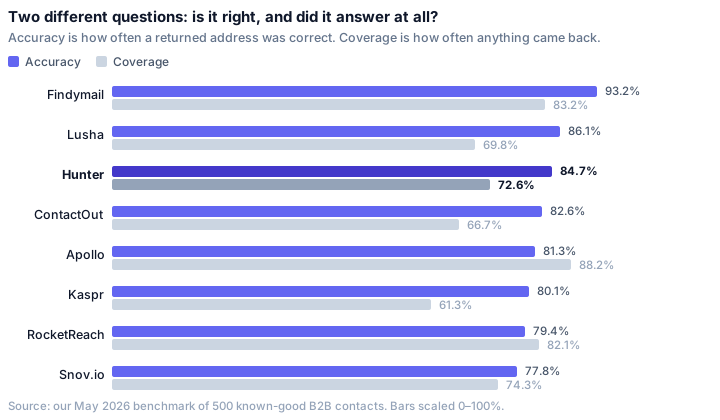
Coverage and accuracy are separate numbers, and vendors quote whichever one flatters them. Three questions keep you honest:
- Coverage of what? A tool that only searches company domains will look worse on a list of freelancers and better on a list of enterprise staff. Hunter’s 72.6% and Apollo’s 88.2% were measured on the same 500 contacts. That is the only reason the two numbers can be compared at all.
- Does a “found” result mean a verified result? At Hunter, Findymail, Anymailfinder, Skrapp and Voila Norbert you’re only charged when something usable comes back. At the big databases a stored record counts as a hit whether or not it still works. That difference makes coverage numbers non-comparable across models.
- What’s the catch-all policy? Catch-all domains accept mail to any address, so nothing can be verified there. Hunter returned catch-all addresses on 14.3% of its results in our test, against Apollo’s 18.7%. Tools that suppress those results post lower coverage and lower bounce rates. That’s the trade, and it’s the whole game — our verification guide has the mechanics.
The Fourteen Alternatives
1. Findymail — the coverage gap, closed carefully
What it fixes about Hunter: the number of blanks. Findymail returned an address for 83.2% of our test lookups against Hunter’s 72.6%, and did it with a lower bounce rate: 1.2% against 4.8%.
Mechanism: finding and verifying in one step, with a proprietary catch-all check. No verification, no result, no charge. Published guarantee of under 5% bounce, or your credits come back.
Price (Aug 2026): $49/month for 1,000 finder credits plus 1,000 verifier credits, $99/month for 5,000. Two months free on annual. Phones cost 10 credits. Credits roll over to 2× the plan.
Free tier: 25 credits, no card.
Best for: people whose next campaign lands on a domain they can’t replace.
Cons:
- Roughly three times Hunter’s cost per credit at the entry tier.
- No unlimited-user policy; Hunter is materially cheaper for a team doing modest volume.
- No domain-pattern view: you don’t get Hunter’s “here is everyone we know at this company, and the pattern.”
2. Anymailfinder — the same promise, cheaper by the thousand
What it fixes about Hunter: price per credit at volume, on the same pay-only-for-verified model. Credits fall from €0.043 at the smallest bundle to €0.007 at 300,000 a year.
Mechanism: every address is verified in real time against the recipient’s mail server before you’re charged, catch-all verification included. The vendor advertises a 97%+ delivery guarantee and, in its own 14-tool benchmark, 86.4% verified coverage at 98.9% accuracy. Those are the vendor’s figures, on the vendor’s test.
Price (Aug 2026): annual credit bundles — €204 for 4,800 credits, €312 for 12,000, €552 for 24,000, €1,032 for 60,000, up to €5,772 for 1.2M. Monthly billing costs about 33% more. Credits roll over while you’re subscribed and repeated searches are free for 30 days.
Free tier: trial credits on signup, no recurring free allowance.
Best for: bulk list building where the per-credit line is what you’re optimising.
Cons:
- Not in our benchmark, so its coverage claim is unaudited by us.
- No phone data, no firmographic search: it’s a finder, nothing more.
- Credits are sold by the year, so the cheap rates need commitment.
3. Prospeo — for building the list, not just resolving it
What it fixes about Hunter: the starting point. 41 search filters, intent topics, lookalikes and personas mean you can go from “mid-market fintech ops leads in Germany” to a list, which Hunter can’t do.
Mechanism: a searchable database with verification at reveal.
Price (Aug 2026): Free; Starter $49/seat/month, or $37 yearly, for 24,000 credits per user per year; Growth $99/$74 for 60,000; Pro $249/$187 for 180,000. Unused credits roll over.
Free tier: 100 credits a month — the most generous recurring free tier on this page.
Best for: solo founders and small teams who need to discover accounts, not just contacts at accounts.
Cons:
- Per-seat, so a team loses Hunter’s unlimited-users advantage.
- Not in our benchmark.
- Credits are granted per year on the paid tiers, so the monthly rhythm is different from Hunter’s.
4. Apollo — the biggest database, with the bounce tax
What it fixes about Hunter: blanks and filters at once. Highest coverage of anything we tested, 88.2%, plus firmographic search, sequencing and a dialer.
Mechanism: a very large stored database with partial verification.
Price (Aug 2026): Free; Basic $49/seat/month billed annually with 30,000 credits a year granted upfront; Professional $79; Organization $119 with a three-seat minimum. Monthly billing costs about 29% more.
Free tier: 900 credits per seat per year, granted monthly.
Best for: anyone who needs to build lists from scratch and will add a verification step.
Cons:
- 7.2% bounce rate in our test, the second-worst of eight, and 18.7% catch-all results. Verify before you send.
- Annual terms are non-cancelable and credits expire with the term. See our Apollo alternatives page if that’s the part you’re escaping.
- Per-seat pricing against Hunter’s unlimited users.
5. UpLead — small lists, high stakes
What it fixes about Hunter: you see verification happen at unlock, and you get firmographics alongside the address.
Price (Aug 2026): Essentials $99/month, or $74 annually, for 170 credits a month; Plus $199/$149 for 400; Professional custom.
Free tier: 5 credits over 7 days.
Best for: target lists of dozens, not thousands.
Cons:
- About $0.44 a contact against Hunter’s €0.017. Twenty-five times the price, for a different job.
- Not in our benchmark.
- Overage credits cost $0.60 each.
6. Dropcontact — the European answer
What it fixes about Hunter: the provenance question. Dropcontact holds no contact database. It computes and verifies addresses algorithmically, and it’s audited against CNIL standards. That is a materially different position to defend in front of a data protection officer.
Mechanism: algorithmic enrichment with native email validation and advanced catch-all verification, charged on success.
Price (Aug 2026): Starter €79/month and Growth €120/month, both with a volume slider running from 500 to 150,000 credits; Enterprise custom above 200,000. Growth adds credit carry-over, LinkedIn enrichment and company-change detection. Yearly billing takes 20% off.
Free tier: 50 credits.
Best for: French and wider EU prospecting, and anyone whose legal team asks where each record came from.
Cons:
- The entry price is high for small volumes, and the slider makes comparison work.
- Enrichment-first: you bring the names, it won’t find them for you.
- Not in our benchmark.
7. Skrapp — LinkedIn-first, and the cheapest per credit
What it fixes about Hunter: the starting point again, from the other direction. Skrapp works from LinkedIn, Sales Navigator and Recruiter, so a profile is enough.
Price (Aug 2026): Free; Professional $29/month billed annually, or $39 monthly, for 2,000 credits a month across 2 users; Enterprise $262/$349 for 50,000 credits across 15 users. Credits roll over, and it advertises charging only for deliverable emails.
Free tier: 50 credits, 1 user.
Best for: prospecting that begins in a LinkedIn tab, on a budget.
Cons:
- Not in our benchmark.
- Daily caps on people and company searches at the lower tiers.
- No phone data.
8. Voila Norbert — simple, and genuinely unlimited on users
What it fixes about Hunter: nothing structural, and that’s the point. It’s the same job with simpler pricing and no per-seat maths at all.
Price (Aug 2026): Valet $49/month up to 1,000 leads; Butler $99 up to 5,000; Advisor $249 up to 15,000; Counselor $499 up to 50,000. Unlimited team members on every plan, bulk and API included, and only successful finds are counted.
Free tier: 50 credits.
Best for: teams who want bulk finding without a credit spreadsheet.
Cons:
- Roughly $0.049 a lead at entry, about three times Hunter’s rate.
- Not in our benchmark.
- Thin integrations: Zapier, no native CRM connections.
9. Snov.io — finding plus sending on one bill
What it fixes about Hunter: campaign depth. Unlimited campaigns, senders and warm-up from $39 a month, where Hunter’s campaign tooling stays deliberately basic.
Price (Aug 2026): Free trial; Starter $39/month for 1,000 credits and 5,000 recipients, or $29.25/month billed annually; Pro S and Pro M scale to 5,000 and 20,000 credits at $74.25 and $141.75 a month on annual billing. Annual discounts run up to 40%.
Free tier: 50 credits a month, renewable every 30 days.
Best for: founders running the whole outbound motion themselves.
Cons:
- Last in our benchmark on both axes that matter here: 77.8% accuracy and 8.1% bounce, against Hunter’s 84.7% and 4.8%. You’d be trading down on data to trade up on features.
- Verification credits are sold separately and you will need them.
- Phones only via expiring add-on tokens.
10. Kaspr — the phone numbers Hunter will never have
What it fixes about Hunter: the missing channel, cheaply. Unlimited B2B email credits plus a phone allowance, working live inside LinkedIn and Sales Navigator.
Price (Aug 2026): Free; Starter €45/seat/month billed annually with unlimited B2B emails, 1,200 phone credits a year and 12,000 exports; Business €79 with 2,400 phone credits and 30,000 exports. Monthly billing is about 25% higher. Subscriptions auto-renew.
Free tier: 15 B2B email credits, 5 phone credits and 5 direct-email credits a month.
Best for: adding dials to an outbound motion that currently only emails.
Cons:
- 61.3% coverage in our test, the lowest of the eight, and 80.1% accuracy.
- Per-seat, so a team pays repeatedly for it.
- The workflow assumes LinkedIn; it’s poor at bulk CSV work.
11. ContactOut — for recruiters, not sellers
What it fixes about Hunter: personal email addresses and phones. Those matter when you’re contacting someone about a job, not about their company’s budget.
Mechanism: LinkedIn profile enrichment with a search portal, ATS integrations and a dialer.
Price (Aug 2026): Free at 5 emails, 5 phones and 5 exports a day, limited to one user per company; the Email plan is listed at $99/month for unlimited emails and 300 exports; Email + Phone at $199. A promotional rate of $25 and $49 was showing when we checked, and a toggle changes the price if you exclude US and UK data — check which variant you’re buying.
Free tier: 5 emails and 5 phones a day. That’s 150 a month if you show up daily.
Best for: talent sourcing and recruiting outreach.
Cons:
- 66.7% coverage in our test, second-lowest.
- The daily free cap only works if your prospecting is daily.
- Built around a recruiting workflow that sellers will find odd.
12. RocketReach — when you have a person, not a company
What it fixes about Hunter: the domain dependency. 700M+ profiles you can search by name, title and location, returning both work and personal addresses.
Price (Aug 2026): Essentials $39/month for 100 lookups, email only; Pro $79 for 250 with phones; Ultimate $169 for 1,000. Annual billing swaps lookup caps for “unlimited” with annual export limits. A lookup is refunded if nothing can be verified.
Free tier: 5 lookups, once.
Best for: research-led prospecting where you start from a name.
Cons:
- About $0.39 a lookup at the entry tier, more than twenty times Hunter’s rate.
- 79.4% accuracy and 6.3% bounce in our test, both worse than Hunter.
- Payments are non-refundable and cancellation takes effect next cycle — see our RocketReach alternatives page.
If it’s the verifier you need, not the finder
Plenty of people arrive at Hunter’s limits with a list they already own. Finder credits are the wrong thing to buy for that.
ZeroBounce. From $99/month for 10,000 validation credits on the ZeroBounce ONE plan, with 20% off annual billing, plus warm-up seeds, inbox placement tests and blacklist monitoring in the same plan. The free tier gives 100 validation credits a month and 10 email-finder lookups. Claims 99.6% validation accuracy. Cons: the minimum purchase is 10,000 credits, a lot to buy if you clean a list twice a year.
MillionVerifier. 100 free credits, a money-back guarantee on results it marked as safe that bounce, and pricing that has long been among the cheapest per check. We could not load its pricing page when we checked, so confirm current tiers with the vendor. Cons: verification only, no finding, and a thinner feature set around the core check.
Our verification tools comparison covers both in depth.
Match Your Wall to a Shortlist
You need phones. Kaspr is the cheap answer at €45 a seat with unlimited emails included, and it works where you already prospect. Cognism is the serious answer if dialing drives your pipeline. Don’t wait for Hunter to add phone data; it isn’t that kind of tool.
You start from LinkedIn. Skrapp at $29 or ContactOut if you’re recruiting. Both begin at the profile, not the domain. That’s the actual mismatch.
You need to discover accounts, not just contacts. Prospeo at $37 a seat or Apollo on the free tier. This is the one wall Hunter can’t be patched around: it resolves companies you name, and neither of those tools charges much to try.
Coverage is the problem. Findymail closes about ten points of it in our testing, or run a waterfall with Hunter first and a second provider catching what it misses. Two providers reached 94.2% coverage in our tests against 72.6% for Hunter alone.
Cost per credit at volume. Skrapp undercuts Hunter slightly on the same monthly basis, about $0.020 against €0.025, and Anymailfinder reaches €0.007 in the largest annual bundles. Both only charge for deliverable results. Check what commitment the headline rate assumes before you celebrate it.
Your DPO is asking questions. Dropcontact computes instead of reselling, a genuinely different answer to “where did this record come from.” Tools built on large resold databases raise a consent question worth putting to your own counsel before the data reaches your CRM.
You already have the list. Skip the finders entirely and buy verification instead. It costs about a cent a check against a couple of cents a lookup, and it solves the actual problem.
Which Alternatives Can You Test for Free?
| Tool | Free volume | Big enough to test on a real list? |
|---|---|---|
| ContactOut | 5 emails + 5 phones/day (~150/mo) | Yes, if you show up daily |
| Prospeo | 100 credits/mo | Yes |
| Apollo | 900 credits/seat/yr (~75/mo) | Yes |
| Hunter | 50 credits/mo | Yes, just — the reference case |
| Snov.io | 50 credits/mo, renewable | Yes, just |
| Skrapp | 50 credits, one time | Borderline, one shot |
| Voila Norbert | 50 credits, one time | Borderline, one shot |
| Dropcontact | 50 credits, one time | Borderline, one shot |
| Findymail | 25 credits, one time | No, but enough to spot-check |
| Kaspr | 15 emails + 5 phones/mo | No |
| UpLead | 5 credits, 7 days | No |
| Anymailfinder | Trial credits on signup | Verify volume at signup |
| ZeroBounce | 100 validation credits/mo | Yes, for verification |
| MillionVerifier | 100 credits | Yes, for verification |
The judgment. Hunter’s own 50 credits a month is a real free tier, not a signup form. Worth remembering while you shop: you can keep it as a baseline forever and test challengers against it for nothing. Prospeo and ContactOut are the only free allowances here that clearly beat it, and ContactOut’s only works if you prospect daily rather than weekly.
What to do this week, at zero cost. Take the 100 contacts Hunter came up empty on — the blanks are the whole reason you’re reading this. Run those names and domains through Prospeo’s and Apollo’s free tiers. If they resolve a meaningful share of your blanks, your problem is coverage and you need a database. If they don’t, your list is simply hard, and no tool on this page will rescue it; what you need is a different sourcing motion. That distinction is worth an afternoon, and it’s the same method as our benchmark in miniature.
Leaving Hunter: What It Costs and What to Take With You
Almost nothing, which is a fair thing to say about a company that sets no traps. Hunter’s help centre is explicit: you can cancel at any time from the Subscription section to stop future auto-renewals, your plan stays active until the end of the billing cycle, you keep unused credits for that duration, and the account then reverts to the free monthly plan. There’s no refund for the unused portion of a term, monthly or yearly, so time the cancellation to the cycle, not to the decision.
Since you keep the free plan afterwards, there’s rarely a reason to close the account at all. Two things are worth doing before the paid term lapses:
- Export your Leads and Lists. Saved leads, verified addresses and campaign data are easier to take with you while the paid plan is live.
- Audit what’s calling the API. Hunter’s API key is often wired into a Google Sheet, a Clay table, a Zap or a CRM enrichment step that someone set up a year ago. Find them before the credits stop, not after a workflow starts failing in silence.
Then, if you’re moving to a tool that also sells verification credits separately, check whether you’re now paying twice for the same check. That’s the most common overlap when people assemble a new stack out of two specialists.
Hunter.io Alternatives: Common Questions
What’s the best free alternative to Hunter? Prospeo, at 100 credits a month, and Apollo at roughly 75. Both recur monthly instead of landing once, and both do something Hunter can’t: build a list from filters. Volumes for everything are in free plans.
Which alternative gives phone numbers? Kaspr at €45 a seat is the cheap route, Cognism the serious one, and ContactOut if you’re recruiting. Hunter has no phone data on any plan, so this is a switch, not an upgrade.
Is there a cheaper email finder than Hunter? Per credit, marginally: on month-to-month billing Skrapp is about $0.020 against Hunter’s €0.025, and Anymailfinder reaches €0.007 only in the largest annual bundles. Compare like with like — most published comparisons put one vendor’s annual rate beside another’s monthly price. Count seats before you decide, though — Hunter includes unlimited users on every plan, so a team of five can end up paying less overall at the higher per-credit rate.
Why does Hunter return nothing for some contacts? Its model works from the company domain and its observed patterns, so it goes quiet when a company is too small or too new to have a detectable pattern, or when you have a person but not their employer. That’s also why it’s more accurate than the big databases when it does answer: it declines instead of guessing. The trade is explained in how to read a coverage number.
Hunter vs Findymail: which is more accurate? Findymail, in our test: 93.2% accuracy and a 1.2% bounce rate against Hunter’s 84.7% and 4.8%, with about eleven points more coverage. Hunter is roughly a third of the price per credit and includes unlimited users, so the answer depends on whether bounces or budget is the thing currently hurting.
Do I need a separate verification tool with Hunter? Usually not. Verification is built in and unsuccessful searches aren’t charged. If you’re importing lists from elsewhere — a conference export, an old CRM segment — a dedicated verifier is cheaper per check than spending finder credits on addresses you already have.
What replaces Hunter’s Domain Search? Nothing does it quite as well. Prospeo and Apollo let you filter a database down to a company’s staff, which gets you to a similar place from the other direction, but Hunter’s pattern detection with source attribution remains the strongest tool in this category for mapping one account.